

Universal High Income
How AI, robotics, and energy abundance could eventually decouple income from work

In a previous article, The Future of Work Is Bigger, Wilder, and More Human Than We Think, we focused on the nearer-term effects of artificial intelligence on jobs, organizations, and careers. That discussion was grounded in what is already visible. AI systems are unbundling roles into tasks, compressing teams, and amplifying individual leverage. Some jobs are disappearing, others are mutating, and entirely new forms of work are beginning to emerge. The central question in that piece was how humans adapt when AI becomes a permanent layer in everyday work.
That framing, however, implicitly assumes that work remains the primary gateway to economic security. If you extend the timeline far enough, that assumption begins to wobble. Once AI and automation mature beyond augmentation and into broad substitution across both cognitive and physical labor, the question stops being how work changes and becomes whether work needs to anchor income at all.
This is the context in which Elon Musk’s idea of Universal High Income should be understood. In late 2023, Musk wrote that in a “positive AI future,” there will be “universal high income, not basic,” and that scarcity would largely disappear aside from what society chooses to keep scarce. He followed that with a strikingly reflective addendum. Even if material needs are solved, he wrote, it is “less clear how we will find meaning in a world where work is optional.”
Taken together, those two thoughts outline a far-horizon vision that is both optimistic and incomplete by design. It imagines abundance as an engineering problem that may be solvable, while leaving meaning as an open human question. Universal High Income, or UHI, is presented as an end state that forces deeper questions about economics, ownership, and purpose in an AI-dominated world.
What would have to be true for Universal High Income to be possible? What kind of economy could support it without collapsing into inflation or scarcity elsewhere? How would it be funded? And how does it relate to the future of work rather than contradict it?
Universal Basic Income has been debated long enough to feel familiar. It is usually framed as a floor. A minimum standard below which no one should fall. The arguments around it are well rehearsed and tend to revolve around cost, incentives, and fairness. Even critics of UBI generally understand its intent.
Universal High Income is something else entirely. The shift from “basic” to “high” changes the scale of the ambition and the nature of the problem. “Basic” is about sufficiency. “High” implies comfort, security, and choice. It implies that income is now a platform for living.
This immediately raises definitional issues. What counts as “high” income depends heavily on geography, household structure, and local cost dynamics. A number that feels generous in one region can feel barely adequate in another.
More importantly, the move from basic to high forces a confrontation with a core economic truth that is often glossed over in income debates. Income is not output. Income is a claim on output. You can increase claims overnight by transferring money. You cannot instantly increase the supply of housing, healthcare, education, energy, or skilled services. If you raise purchasing power broadly without expanding real capacity, prices rise. The result is inflation, not prosperity.
This is why Musk’s reference to the disappearance of scarcity is the condition that makes Universal High Income coherent. Without real abundance across the sectors people spend money on, UHI becomes a redistribution engine that pushes demand into bottlenecks and rewards whoever owns the constrained supply. With abundance, higher income translates into real gains in living standards.
Universal High Income, then, is less about checks and more about whether AI and automation can fundamentally change the supply side of the economy.
In 2017, speaking at the World Government Summit, Musk argued that automation would steadily eliminate jobs and that “some kind of universal basic income is going to be necessary.” That framing was defensive. It described UBI as a stabilizer in a disruptive transition.
The later shift to “universal high income” reframes the endpoint. Instead of focusing on preventing social breakdown, it imagines a future where productivity has expanded so dramatically that a strong standard of living can be shared broadly. The emphasis moves from mitigation to upside.
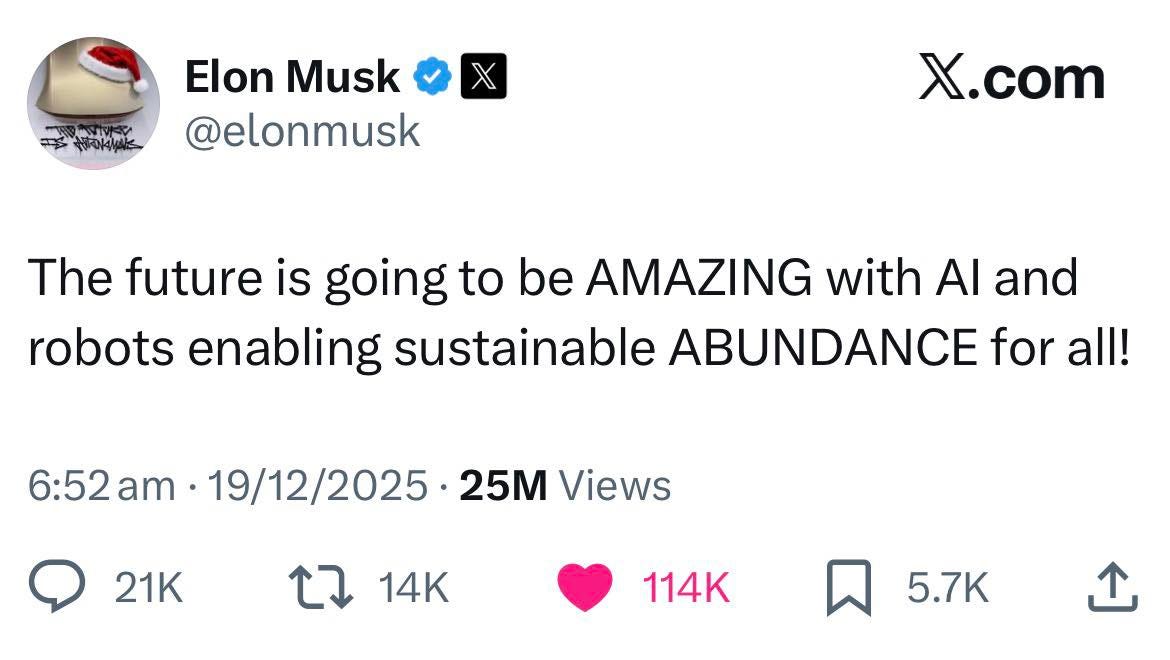
By 2025, Musk went further, speculating that advanced AI and robotics could make money itself feel less central, while still acknowledging constraints like electricity and physical resources. That caveat signals that even in his most optimistic scenarios, abundance is not magic. It is bounded by physics and infrastructure.
Seen this way, Musk’s optimism is not careless. It is conditional. It assumes continued progress in AI, robotics, energy, and manufacturing. It also assumes that society chooses to distribute the gains rather than allow them to concentrate indefinitely.
The future of work and the future of income are related but not identical problems. In the near to medium term, AI reshapes work rather than eliminating it wholesale. Tasks are automated, workflows are compressed, and individuals gain leverage. Work becomes more fluid, more project-based, and in some cases more human because routine tasks fall away.
Universal High Income operates on a longer timeline. It assumes a world in which automation is no longer confined to cognitive assistance but extends deeply into physical labor. In that world, the connection between hours worked and economic security weakens. People may still work, but work stops being the primary mechanism for distributing income.
In a wage-based system, automation feels threatening because it undermines the link between effort and survival. In a UHI system, automation can feel liberating because security is decoupled from employment. The same technology produces radically different social outcomes depending on the distribution framework wrapped around it.
A crucial constraint on the UHI vision is that today’s AI revolution is still largely digital. It has transformed language, media, analysis, and code. That is significant, but it does not automatically make rent cheaper or healthcare more accessible.
The biggest expenses in most households are tied to the physical economy: housing, healthcare, education, childcare, transportation, food, and energy. Universal High Income only feels “high” if the cost of these goods and services falls or becomes more elastic.
This is where robotics and physical automation become decisive. Software alone cannot build houses faster, care for the elderly at scale, or deliver medical services cheaply. Intelligence has to be paired with dexterity, mobility, and reliability in the real world.
Musk’s optimism about UHI is inseparable from his focus on robotics and manufacturing. His worldview assumes that AI migrates into factories, construction sites, logistics networks, and service environments. If automation remains narrow, abundance remains narrow. If automation becomes broad, abundance can follow.
Housing illustrates the point clearly. Housing scarcity in many regions is driven by a mix of labor costs, regulatory friction, financing structures, and slow construction processes. AI can accelerate design and planning. Robotics can reduce labor costs and speed up builds. But policy barriers must also shift. Without supply expansion, higher incomes simply inflate prices.
Healthcare follows a similar pattern. Administrative automation and diagnostic support can reduce costs at the margin, but real abundance requires scalable delivery models that reduce dependence on scarce human labor. Universal High Income assumes that these systems evolve alongside AI.
An AI and robotics economy is energy-intensive. Compute requires power. Automation requires power. Electrified logistics requires power. Musk has repeatedly acknowledged that even in a post-scarcity vision, electricity and physical resources remain constraints.
This acknowledgment grounds the UHI discussion in reality. If energy remains scarce, expensive, or politically blocked, abundance caps out. If energy becomes abundant, cheap, and reliably deliverable, many other constraints loosen simultaneously.
In this sense, UHI is indirectly a thesis about infrastructure. It assumes societies can build grids, generation capacity, transmission, and storage at scale. It assumes that permitting and governance adapt to support expansion rather than impede it. Abundance is not just technological. It is institutional.
Even if AI and automation massively expand productivity, the gains do not distribute themselves. By default, they flow to the owners of capital: data centers, models, robots, factories, and intellectual property. Universal High Income is therefore a deliberate societal choice.
There are two broad approaches to making that choice. One is tax-and-transfer. The other is a social dividend model based on shared ownership or shared claims on productive assets.
The Alaska Permanent Fund Dividend is often cited because it demonstrates that universal cash payments can be politically durable when framed as dividends rather than redistribution. The fund’s payout mechanism ties distributions to long-term asset performance, smoothing volatility and reinforcing legitimacy. While Alaska’s dividend is not UHI, it shows how distribution mechanisms can be designed to endure.
Scaling such a model to an AI economy would require society to accumulate ownership or claims on the automated productive base, possibly through sovereign wealth funds, royalties, or hybrid tax structures. The details are complex and contested, but the principle is consistent. If the economy becomes more capital-driven, broader capital participation becomes one path to broader income.
At basic levels, universal payments can be debated as one program among many. At high levels, they become central to fiscal architecture. Funding UHI would require rethinking tax bases in a world where labor income may shrink as a share of total output.
Consumption taxes attract attention because consumption does not disappear when work changes shape. Value-added taxes are widely used globally and can raise substantial revenue. Paired with universal payments, they can preserve progressivity depending on design.
Capital and profit taxation becomes more relevant in an automation-heavy economy, but it is also more mobile and sensitive to avoidance. Automation or “labor equivalent” taxes are conceptually appealing but difficult to implement cleanly without discouraging productivity.
The most plausible funding path is a hybrid system that combines broad-based taxes with mechanisms that explicitly link distributions to the growth of the automated economy. The goal is not to punish innovation but to ensure that its gains are shared.
Empirical evidence from basic income experiments offers cautious optimism. Finland’s basic income trial found no significant employment effects while improving wellbeing and reducing stress. Alaska’s dividend has not reduced aggregate employment, though it has shifted some work patterns toward part-time roles.
These findings suggest that unconditional cash does not automatically erode motivation. They do not, however, prove what happens when payments are large enough to replace most wages. Universal High Income remains largely untested territory.
The optimistic case assumes that automation fills labor gaps as people reduce work hours, preserving output while increasing freedom. The pessimistic case assumes shortages emerge in human-dependent services, raising prices. The difference hinges on whether abundance reaches the sectors that matter most.
The most revealing part of Musk’s Universal High Income comment is not the income itself but the question about meaning. Work has long served as a source of identity, status, and structure. Removing its necessity creates freedom but also uncertainty.
A positive interpretation is that UHI allows people to redirect effort toward activities that are currently undervalued economically: caregiving, community building, creative work, learning, and exploration. It may also lower the cost of risk-taking and entrepreneurship.
But this shift would require cultural adaptation. Societies would need new norms and institutions that help people build purpose outside traditional employment. Just as universal education became foundational in industrial economies, a post-work society may require new forms of civic and creative infrastructure.
Musk’s framing is useful precisely because it does not pretend that abundance solves everything. It acknowledges that meaning remains a human project.
We will continue to explore this topic in greater depth in our upcoming articles.
Views expressed in posts, including articles, podcasts, videos, and social media, are those of the individual E1 Ventures personnel quoted in them and do not necessarily reflect the views of E1 Ventures, LLC or its affiliates. The posts are not directed to any current or prospective investors. They do not constitute an offer to sell or a solicitation of an offer to buy any securities and may not be used or relied upon in evaluating the merits of any investment.
The material available here, as well as on any associated distribution platforms or public E1 Ventures social media accounts and sites, should not be interpreted as investment, legal, tax, or other professional advice. You should consult your own advisers regarding legal, business, tax, and related matters concerning any investment. Any projections, estimates, forecasts, targets, or opinions contained in these materials are subject to change without notice. They may differ or be contrary to opinions expressed by others. Any charts or data included in these materials are for informational purposes only and should not be used as the basis for any investment decision. Certain information contained here has been obtained from third-party sources. While such information is believed to be reliable, E1 Ventures has not independently verified it and makes no representation regarding its accuracy or suitability for any particular situation. Some posts may include third-party advertisements. E1 Ventures has not reviewed such advertisements and does not endorse any of the content contained in them. All posts speak only as of the date indicated.
Nothing contained on Substack or on associated content distribution platforms should be construed as an offer to purchase or sell any security or interest in any pooled investment vehicle sponsored, discussed, or mentioned by E1 Ventures personnel. Nothing here should be interpreted as an offer to provide investment advisory services. Any offer to invest in an E1 Ventures–managed vehicle will be made separately and only by means of the respective fund’s confidential offering documents. Those documents must be reviewed in their entirety and are made available only to individuals or entities that meet specific qualifications under federal securities laws. These investors, which include only qualified purchasers, are considered capable of evaluating the merits and risks of potential investments.
There can be no assurances that E1 Ventures’ investment objectives will be achieved or that its investment strategies will be successful. Any investment in a vehicle managed by E1 Ventures involves significant risk, including the possible loss of the entire amount invested. Any investments or portfolio companies described or referred to here are not representative of all investments made by E1 Ventures, and there can be no assurance that such investments will be profitable or that future investments will achieve comparable results. Past performance of E1 Ventures’ investments, pooled vehicles, or strategies is not necessarily indicative of future results. Some investments, including certain publicly traded assets, may not be listed if the issuer has not granted permission for public disclosure.
E1 Ventures may invest in various tokens or digital assets for its own account. In doing so, E1 Ventures acts in its own financial interest. It does not represent the interests of any other token holder and has no special role in managing or overseeing any such projects. E1 Ventures does not undertake to remain involved in any project beyond its position as an investor.
Wow…Optimus, it’s your turn now